Past, Present, Future: The Line That Holds Your Whole Story
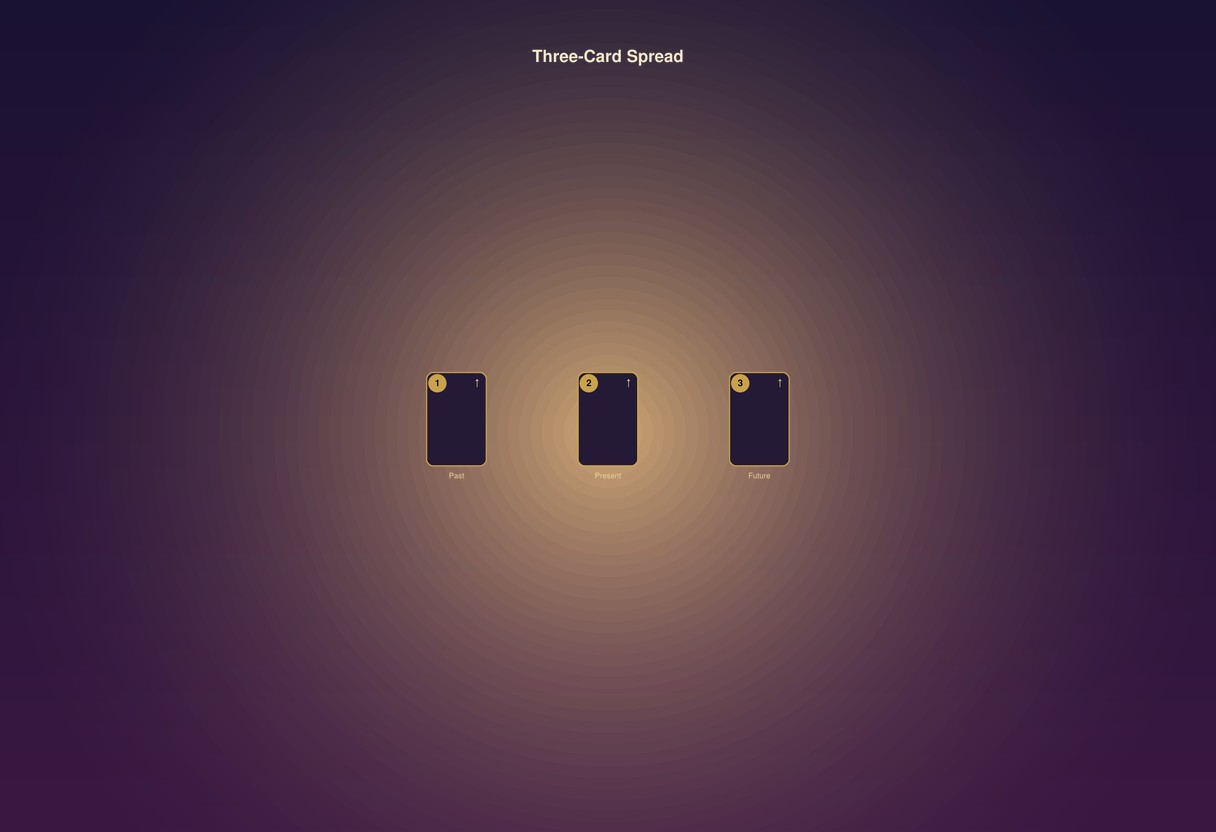
Three cards, laid left to right, is the first spread most readers ever learn, and a lot of them never really leave it. That's not a failure of ambition. It's because the three-card line does something no sprawling twelve-card layout can: it forces a story into a shape you can hold in your head all at once. Past. Present. Future. Left, middle, right. There's nowhere for the reading to hide, and nowhere for you to hide from it either.
Why Three Is Enough
The spread's structure is almost stubbornly plain. Card one is the Past — the influences and events that shaped how you arrived here, not necessarily the whole history but the parts of it still exerting pressure. Card two is the Present — the situation you're actually standing in, the energies around you now, today, not last year and not next month. Card three is the Future — the likely outcome or direction if the current path continues, the trajectory the present moment is already leaning toward. No card explains itself; each one only makes sense in relation to the other two. That relational reading is the whole craft of this spread. A single card face-up on a table is a symbol. Three cards face-up in a row are a sentence, and sentences carry meaning that lone words can't.
Reading the Arc, Not Just the Cards
The temptation with any spread is to read each position in isolation, like three separate one-card pulls that happen to share a table. Resist it here especially. The three-card spread rewards readers who look at the distance between positions — how far the Present card has traveled from the Past card, and how much room is left between the Present and the Future. If the Past shows a card of conflict and the Present shows one of resolution, you're not just seeing three static facts. You're watching a shift happen in real time, mid-sentence. And if the Present and Future cards echo each other closely, that's information too — a sign the current trajectory has real momentum behind it, for better or worse.
The past card doesn't explain what happened to you. It explains what's still happening, quietly, underneath everything you're doing today.
Why It's the Spread Most People Come Back To
Part of what makes this layout endure is how honest it is about its own limits. It doesn't pretend to map your whole year or diagnose a relationship's every fault line. It commits to one arc, cleanly told, and lets the Future card stay what it always is in tarot — a direction, not a decree, and one that bends the moment you act differently in the Present. That's a feature, not a caveat. A three-card pull is fast enough to do daily, honest enough to trust, and structured enough that even a first-time querent walks away with something coherent rather than a pile of loose symbols. It's often the spread that teaches new readers how to actually read, rather than just recite meanings, because there's nowhere to hide behind extra cards.
If you'd rather have someone else lay the cards and walk the arc with you, Kyshara's readings include this exact spread as a live session. Otherwise, keep exploring The Kyshara Realm as new reflections arrive.