Three Cards and a Straight Answer
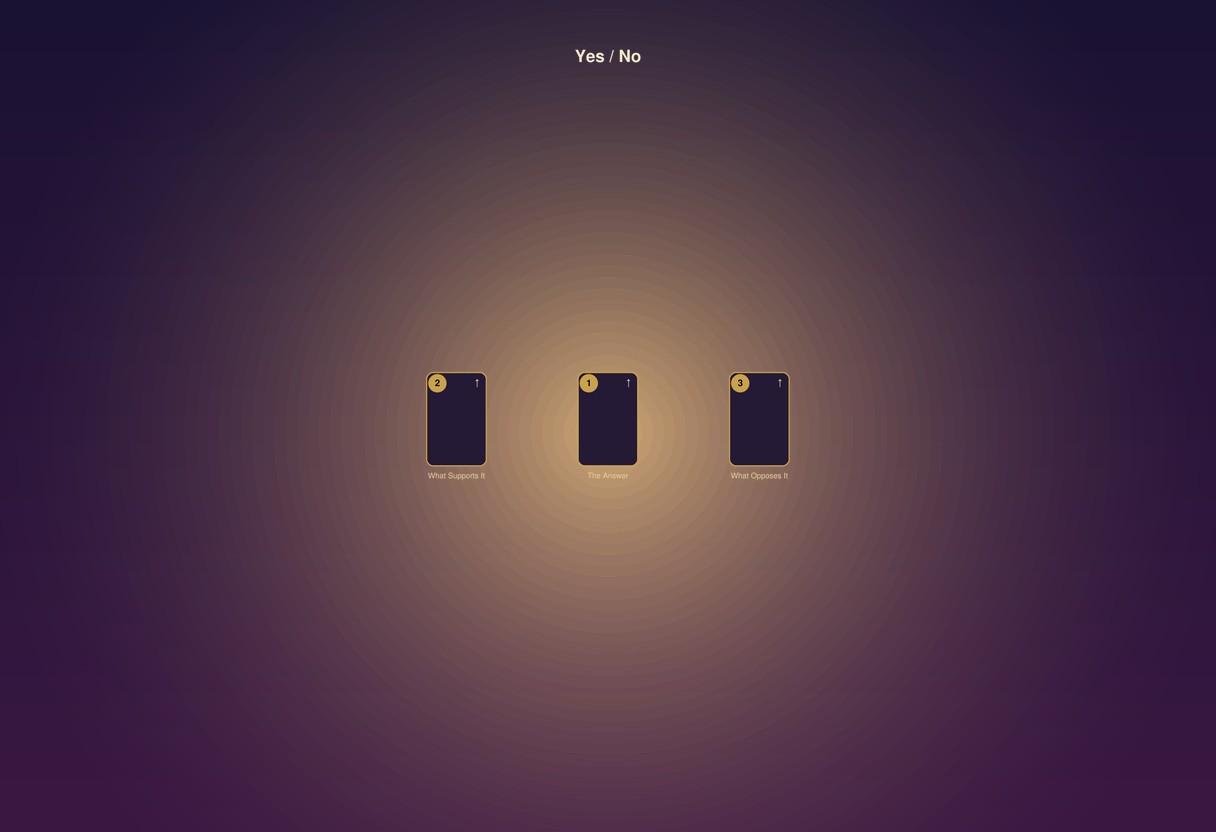
Tarot has a reputation for refusing to answer plainly, and most of the time that reputation is earned — the Fool doesn't tell you whether to take the job, he tells you how to feel about the cliff. The Yes/No spread is the exception, built specifically to cut through that. Three cards, one focused question, and a structure designed to actually land on a verdict rather than circle one indefinitely.
An Orientation-Weighted Verdict
The first position, The Answer, is the spread's core mechanism, and it works differently from most tarot positions: it's the core verdict, orientation-weighted toward yes when the card lands upright and toward no when it lands reversed. That's a deliberate departure from the more open symbolic reading most single cards get in other contexts, where upright and reversed usually just shade a meaning rather than flip a verdict. Here, orientation isn't a minor inflection on the card's broader meaning — it's doing real interpretive work, tipping the answer itself in one direction before you've even factored in what the card's imagery actually shows.
The Case For, and the Case Against
The Answer alone would be a one-card pull with a coin-flip feel to it, which is why the spread doesn't stop there. Position two, What Supports It, lays out the energies favouring a yes — the momentum, resources, or alignment already working in that direction, whether or not the querent has noticed them yet. Position three, What Opposes It, does the same work for no: the resistance, the missing piece, the friction the question hasn't accounted for. Reading these two against each other is where the spread stops being a coin flip and starts being an argument, with The Answer as the ruling and the other two cards as the evidence submitted on each side of the case. A confident Answer card flanked by weak support and strong opposition is worth noticing before you accept the verdict at face value.
A card in the Answer position isn't the whole verdict. It's the verdict before cross-examination — and the other two cards are where the cross-examination happens.
What This Spread Is Honest About
The Yes/No spread works best on questions specific enough to actually have a yes or no — not "what should I do with my life" but "should I take this offer," not vague longing but a real fork sitting in the road ahead. Ask it something too broad and even a strongly-oriented Answer card won't have anywhere clean to land. Ask it something concrete, and the tension between What Supports It and What Opposes It usually tells you more about your own hesitation than the verdict card does sitting there on its own. That tension is often the most useful part of the reading, more than the yes or no itself.
For a live version of this exact question-and-verdict format, Kyshara offers it directly through Kyshara's readings — or keep exploring more spreads and reflections at The Kyshara Realm.