Situation, Action, Outcome: The Spread That Refuses to Just Describe Your Life
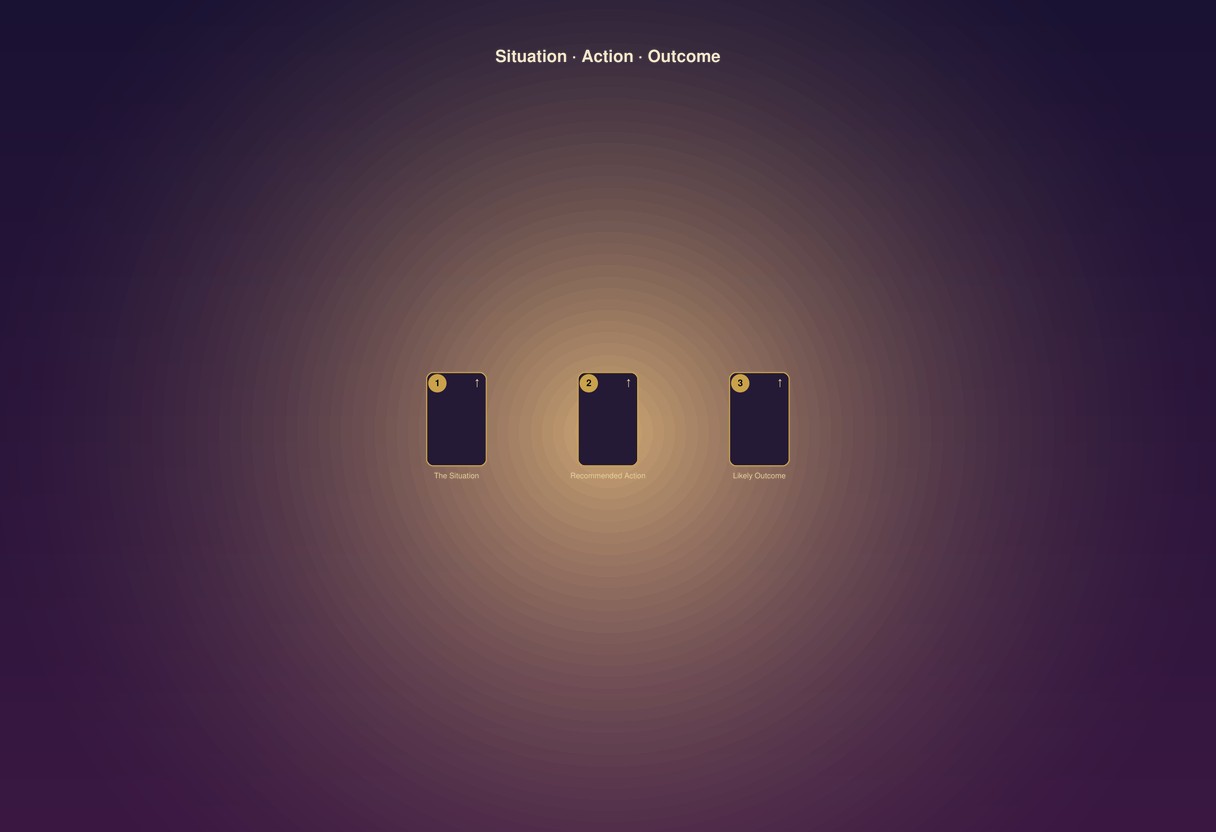
Ask any longtime reader which spread they reach for when someone corners them at a party with "can you do a quick reading," and most will say the same thing: three cards, laid left to right, done in under five minutes. Past-present-future is the famous version of this. Situation, Action, Outcome is the more useful one. It keeps the three-card economy but swaps out the passive tenses for something with a spine. It doesn't just narrate your circumstances back to you. It asks what you're going to do, and what happens if you do it.
The Situation Isn't Just "What's Happening"
The first card sounds like a warm-up, but it's doing real diagnostic work. This isn't a general weather report on your life — it's a request for the central energy of the specific thing you're asking about. If you've come to the cards with a real question (should I take the job, is this relationship worth repairing, why does this keep happening), the Situation card is being asked to name the animating force underneath it, not just restate the facts you already know. A card like the Nine of Wands here isn't telling you that you're tired, which you already knew. It's telling you that exhaustion has become the lens you're viewing everything through, and that matters for how you read the next two cards.
Recommended Action Is Where the Spread Earns Its Name
This is the position that separates this layout from nearly every other three-card draw. It doesn't ask what will happen. It asks what to do. That's a harder, more exposed kind of card to receive, because advice can be ignored in a way that description can't. Get the Eight of Swords here and the temptation is to read it as more bad news. It isn't. In the Action position, the Eight of Swords is a direct instruction: the binding is self-imposed, so remove it yourself. Get the Chariot and the instruction is just as direct — stop deliberating and commit to a direction, even an imperfect one. The Action card is the closest tarot gets to a coach's voice.
The middle card isn't a mirror. It's a hand pointing toward the door.
Likely Outcome, Not Guaranteed Outcome
The third position gets misread more than the other two combined, usually because people treat it as a verdict. It isn't fixed weather; it's a probability, and it's a probability that's explicitly conditioned on the middle card. The Outcome position is answering a specific question: if you take the recommended action, where does that lead? Change the action and you change the outcome — which is exactly why this spread resists fatalism better than most. A frightening card in the Outcome slot, like the Tower, isn't a prophecy to dread. Read against the Action card that came before it, it's usually saying the structure you're bracing to protect was never going to hold anyway, and the action already pointed you toward something sturdier.
Why the Order Matters More Than the Cards
Shuffle the same three cards into a different sequence and the reading changes completely, which is the whole point of a positional spread over a general pull. Situation explains the terrain. Action gives you a compass bearing. Outcome shows you the likely destination if you actually walk that bearing instead of standing still and rereading the map. It's a spread built for people who came for guidance, not commentary — which is why it's the one seasoned readers keep coming back to when the question is real and the person asking wants an answer they can use before Tuesday.
If you'd rather have someone else lay the cards and walk the sequence with you, Kyshara's readings include this exact spread, or explore more of The Kyshara Realm as new reflections arrive.