The Celtic Cross: Ten Cards, One Question, No Shortcuts
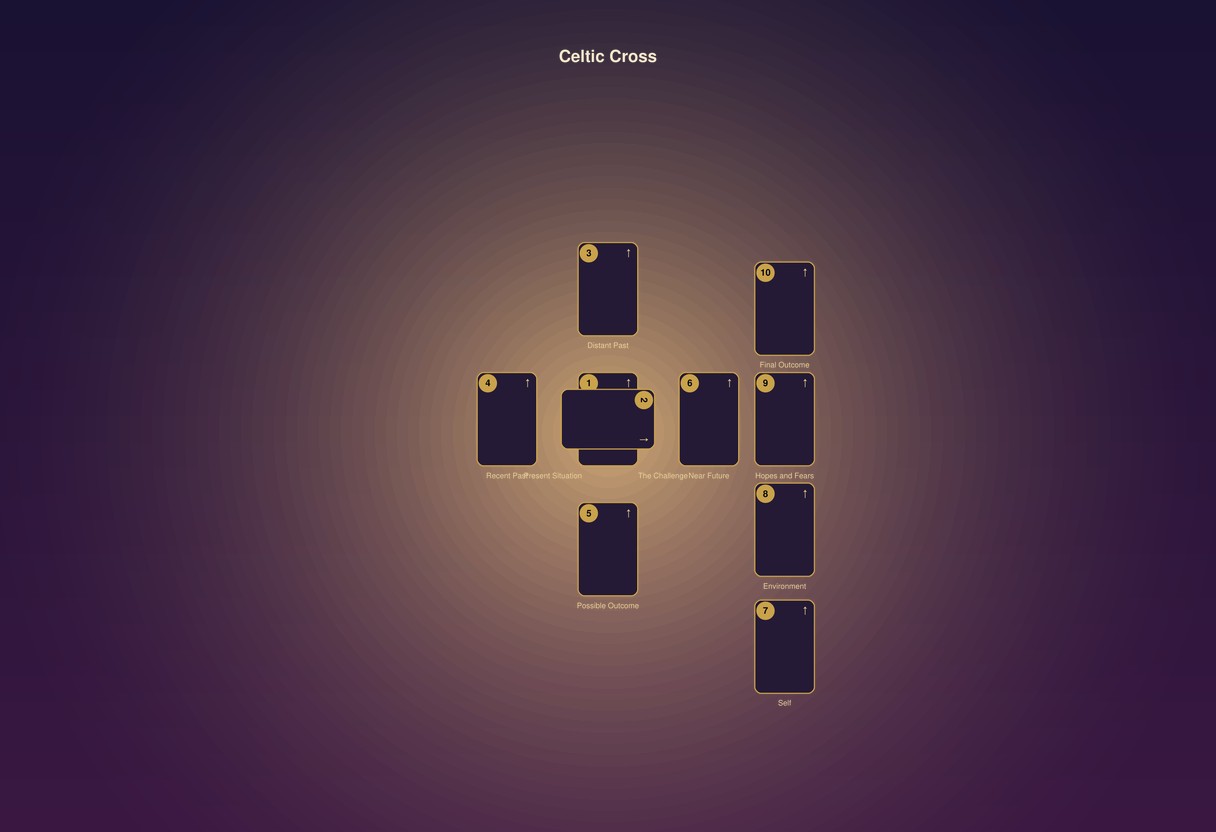
Ask ten different tarot readers where the Celtic Cross comes from and you'll get ten slightly different histories, but ask them whether they use it and almost all of them will say yes. It's the spread most people picture when they picture a tarot reading at all: a cross of six cards with a staff of four running up the side, ten pieces of a single situation laid out so thoroughly that by the end there's nowhere left for the question to hide. It rewards patience in a way three-card spreads simply don't have room for.
The Cross: Present, Challenge, and the Weight of History
The first two cards form an X at the centre — Present Situation, your current state of mind and the central theme, crossed directly by The Challenge, whatever complicates or contests it. Around them sit two cards of time: Distant Past, the past events that form the foundation of the issue, and Recent Past, the influences just passing out of your life. This is where the Celtic Cross does something most spreads skip entirely — it insists the present didn't arrive from nowhere, and asks the reader to actually trace the line backward before saying anything about the future.
By the time you reach the sixth card, you're no longer asking what will happen. You're asking what you're bringing into it.
Possible Outcome and Near Future: Two Different Kinds of Ahead
Position five, Possible Outcome, names the best that can be achieved in this situation — a ceiling, not a promise. Position six, Near Future, is more immediate and less negotiable: what's coming regardless, in the short term. Reading these two together is genuinely instructive, because they rarely agree completely, and the gap between them is often exactly what the querent needs to see.
The Staff: Self, Environment, Hopes and Fears, and the Final Word
The four cards running up the right side turn the lens inward and outward in alternation. Self asks about your own attitude, how you see yourself in this. Environment asks how the people around you see or affect the situation — a position that catches a lot of readers off guard, because it's rarely as flattering as the querent expects. Hopes and Fears sits in the same card position deliberately, because in tarot practice the two are so often tangled together that separating them does the querent a disservice. And then, at the top of the staff, Final Outcome: the most likely result if things continue on their current course. Not fixed, not fated — just where the road currently points.
It's a long spread, and it's meant to be. Ten cards is enough room for a situation to actually show its edges instead of getting summarised. If you want it read for you rather than laid out alone at a kitchen table, Kyshara's readings offers the Celtic Cross as one of its core sessions. More reflections like this one live over at The Kyshara Realm.