The Doll Who Guards the Stove: Kitchen Witchery's Quiet Lineage
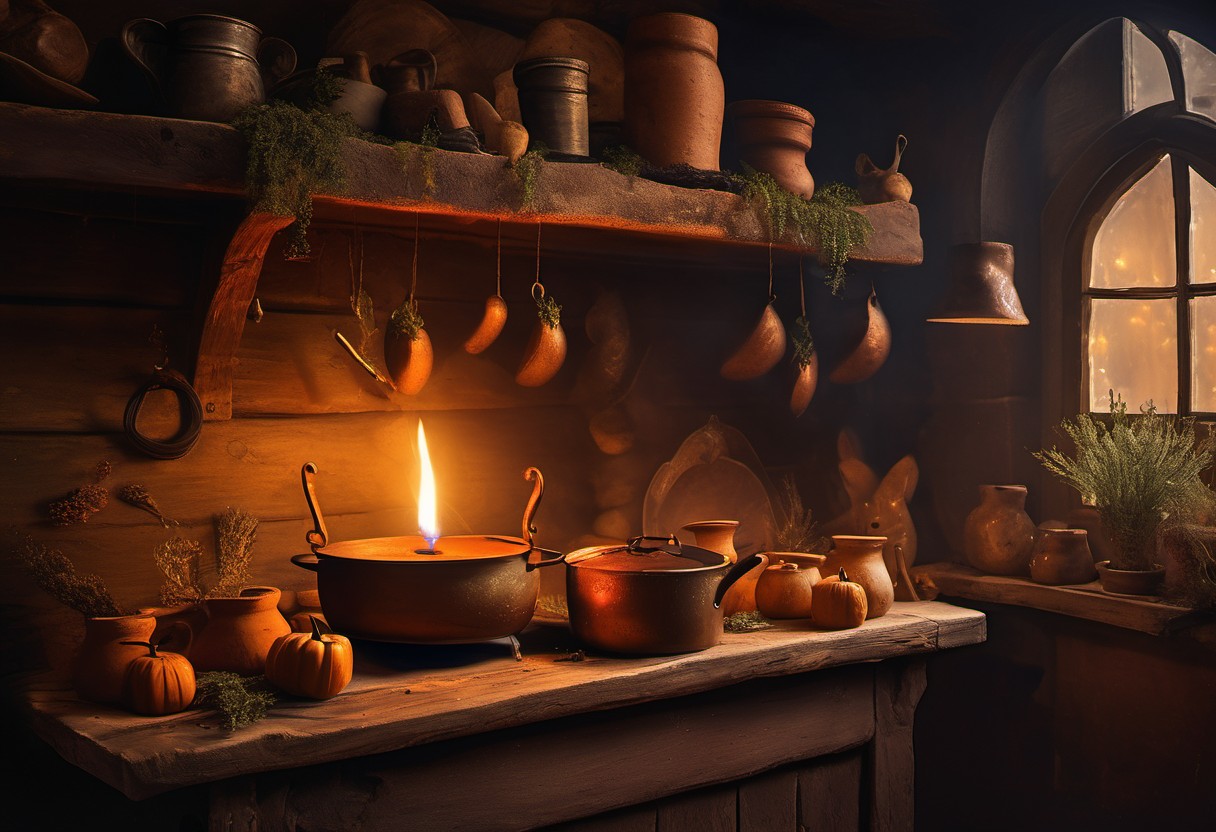
In farmhouses across Scandinavia and Germany, a small doll used to hang near the stove. She rides a broom, wears a kerchief, and carries a spoon or a basket of dried herbs. She's called a kitchen witch, and unlike the pointy-hatted villain of fairy tales, her entire job was to be helpful. Tradition holds that hanging her in the kitchen kept meals from burning, kept the household fed, and kept whatever bad luck was floating around outside from crossing the threshold into the pantry. She's a caretaker, not a curse.
That doll is a fairly late arrival — the collectible version many people know took shape in the twentieth century — but she's standing in for something much older. Hearth magic is one of the most widespread folk practices on record, because the hearth was the actual center of the home: the only reliable heat, the only way to cook, the place a family gathered by necessity every single day. Keeping it in good favor wasn't superstition layered on top of survival. It was survival, with a layer of intention added.
The Hearth as the First Altar
Ancient Rome kept the practice formal enough to have its own priesthood: the Vestal Virgins tended a public hearth fire that was never allowed to go out, because the fire's continuity stood in for the city's own. Greek households kept a similar devotion to Hestia, goddess of the hearth, with the first and last words of any meal traditionally offered in her name. Slavic folklore has the domovoi, a household spirit said to live behind or beneath the stove, who had to be kept content with small offerings of bread or porridge left out overnight. Different continents, different names, same underlying instinct — the place where fire meets food deserves respect.
Kitchen witchery was never about spectacle. It was about noticing that the person who feeds a household is already doing something that shapes it.
Cooking as an Act of Intention
What modern kitchen witchery borrows from all of this is less the specific deities and more the underlying posture: that the person stirring the pot is doing more than following a recipe. Stirring clockwise for "gathering" energy and counterclockwise for "release," saying a small word of thanks before a meal, choosing rosemary because it's traditionally associated with remembrance, or baking bread on a morning when you specifically want the day to go well — these are gestures of attention laid over an ordinary task. Many practitioners believe the intention behind the stirring matters as much as the ingredients. Nothing here requires a special tool. A wooden spoon that's been in a family for three generations carries more of this than anything bought new.
An Everyday Practice, Not a Performance
What separates kitchen witchery from more ceremonial forms of folk magic is exactly this lack of theater. There's no robe, no circle, no moon required. It happens standing at a counter that also needs to be wiped down afterward, on a Tuesday, while something is simmering and the radio is on. That ordinariness is the whole point — the tradition holds that magic doesn't need a special occasion to be real, it just needs someone paying attention. A kitchen witch doll on a hook by the stove is really just a reminder to keep doing that.
Curious what else lives in this tradition of everyday intention? Explore more of The Kyshara Realm, or read more on what Kyshara is building here.