The Shadow Work Spread: Six Cards Into the Room You Keep Locked
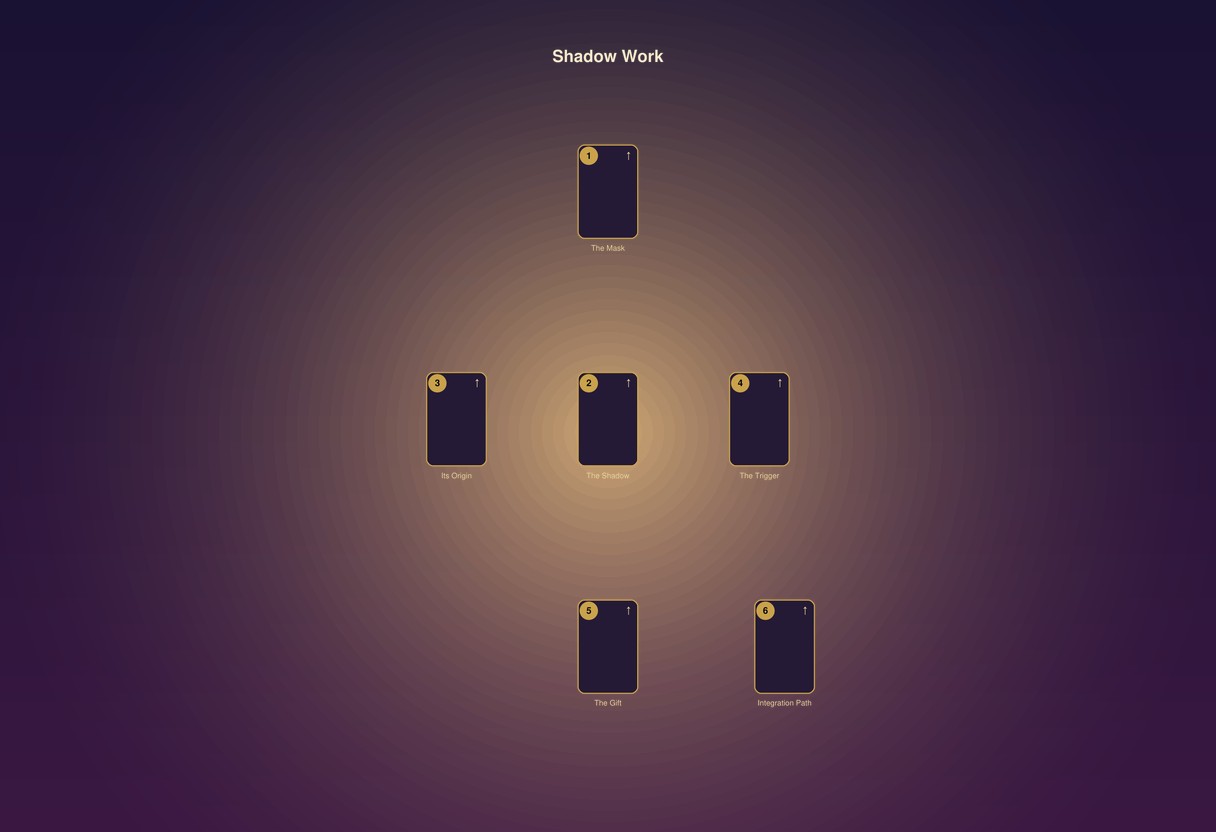
Most spreads move outward, toward a decision, a timeline, an answer about someone else. The shadow work spread moves the opposite direction. Six cards, laid in sequence, and every one of them points back at you. It doesn't ask what will happen. It asks what you're carrying that you haven't looked at directly, and it refuses to let you stop at naming it — it wants the origin, the trigger, and, eventually, the use you can make of it. This is not a comfortable spread. It isn't supposed to be.
The Mask and the Shadow: Two Cards, One Argument
The spread opens with a deliberate pairing. The first position, the Mask, is the persona — the version of you that shows up to work, to family dinners, to whoever is watching. The second position, the Shadow, is what that mask was built to cover: the trait, urge, or wound you've decided isn't allowed in public. Laid side by side, these two cards are meant to be read as a contrast, almost an argument. If the Mask comes up as the Queen of Swords — composed, articulate, in control — and the Shadow comes up as the Two of Cups reversed, the reading isn't subtle. It's suggesting the composure is doing a lot of work to keep a fear of real intimacy out of view. The spread wants you to see the gap between those two cards before it lets you go any further.
Origin and Trigger: Where It Came From, What Wakes It Up
This is the part of the spread that keeps it from being a parlor trick. Positions three and four aren't decorative — they're the mechanism. The Origin asks where this shadow was actually formed, a different question from what it is. A card like the Four of Pentacles here often points backward to scarcity, real or perceived, learned early and never fully unlearned. The Trigger, in position four, is more immediate: what sets this pattern off in an ordinary Tuesday. The Five of Wands in this slot rarely means literal conflict. More often it's naming competition, or the feeling of being overlooked, as the specific spark. Read together, Origin and Trigger turn a vague "I do this sometimes" into something you can actually recognize the next time it starts.
The shadow was never the enemy. It was the part of you that learned to survive something, and never got the memo that the danger passed.
The Gift Hiding Inside the Thing You Hate About Yourself
Position five is where this spread earns its reputation as more than an exercise in self-criticism. Every shadow, it insists, is carrying something useful underneath the discomfort — not as consolation, but as fact. The same hypervigilance that exhausts you might be the root of genuine perceptiveness. The same fear of failure that stalls you might be evidence of standards worth having, misapplied. A card like the Nine of Swords in the Gift position isn't telling you your anxiety is secretly fine. It's telling you the same mind that spirals at 3 a.m. is capable of anticipating problems before anyone else in the room notices them — and that capacity has a legitimate use once it's not running unsupervised.
Integration Isn't a Fix. It's a Job.
The final position doesn't offer resolution so much as a next action. Integration, here, means the shadow stops being managed from the outside — hidden, denied, apologized for — and starts being handled on purpose. A card like Temperance in this slot is about as literal as tarot gets: the instruction is to blend, not banish. The spread was never going to end with the shadow gone. It ends with the shadow employed.
Working through all six positions with a reader who can hold the thread from the Mask to Integration is available through Kyshara's readings — or keep exploring on your own with more of The Kyshara Realm.
The Spiritual Bundle combines Shadow Work, Spiritual Path and Soul Journey readings at a bundle price.