The Healing Journey Spread: Seven Cards for the Parts of You That Are Still Catching Up
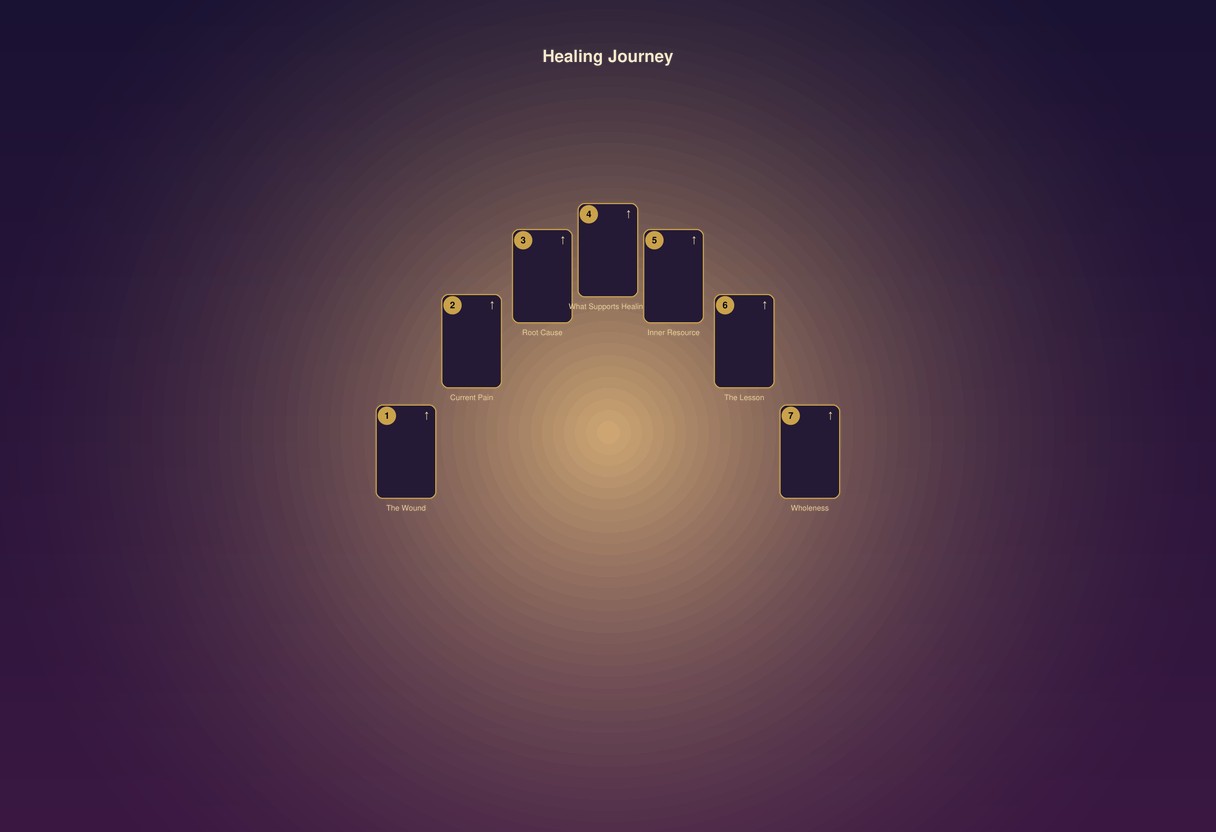
Healing rarely arrives on schedule. It's not a light switch — one day broken, the next day fine. It's more like weather moving through a valley: it clears in one place while it's still raining somewhere else in you. The Healing Journey spread was built around that unevenness. Instead of asking one card to summarize how you're doing, it lays out seven, each one responsible for a different piece of the terrain — the original wound, the way it shows up today, where it started, what's actually helping, what you're capable of on your own, what it's trying to teach you, and what waits on the other side of it.
The First Three Cards Are About Honesty, Not Diagnosis
Positions one through three ask you to look at the same injury from three different distances. The Wound names what needs healing in plain terms — not the story around it, just the thing itself. Current Pain asks how that wound is behaving right now, in this season of your life, because old injuries rarely stay still; they flare, they go quiet, they resurface at strange hours. Root Cause pulls the lens back further and asks where this actually began, which is often earlier and stranger than the obvious answer. Reading these three together tends to surface a gap people don't expect: the thing that hurts today and the thing that started it are frequently not the same event at all.
The Root Cause card rarely agrees with the story you'd tell a friend about why you're hurting — and that disagreement is usually where the real information is.
Support Is External, Resource Is Internal — and the Spread Insists on Both
Positions four and five sit next to each other for a reason. What Supports Healing looks outward: the people, practices, and circumstances currently helping you, whether or not you've given them credit. Inner Resource looks inward: the part of you that would keep healing even if every one of those external supports vanished tomorrow. It's easy to lean entirely on one or the other — to either wait for outside rescue or insist on doing everything alone. Seeing both cards side by side is often the spread's quiet correction. Healing that lasts tends to need both a hand to hold and legs that can eventually walk without it.
The Lesson Isn't a Reward for Suffering
Position six, The Lesson, is the card people brace for, expecting it to justify the pain as somehow necessary. It doesn't have to. Sometimes the lesson a wound teaches is simply about limits — what you'll no longer tolerate, what you now recognize faster, what you refuse to repeat. That's not the universe balancing its books; it's just what attention produces when it's paid consistently to the same sore spot over time.
Wholeness Is a Position, Not a Promise
The seventh card, Wholeness, doesn't claim the wound will vanish or that scar tissue disappears. It describes life on the other side of the active healing — what becomes possible once this particular ache stops running the show. Reading it last, after six cards of unglamorous groundwork, keeps it honest: wholeness here is earned by the sequence, not handed out for free at the end of it.
If this way of mapping a wound feels useful, Kyshara's readings offers the Healing Journey spread as a live seven-card reading. Or keep browsing The Kyshara Realm for more of these as they're added.