Tarot: A Card Game's 500-Year Journey Into Myth
A mirror to the moment.
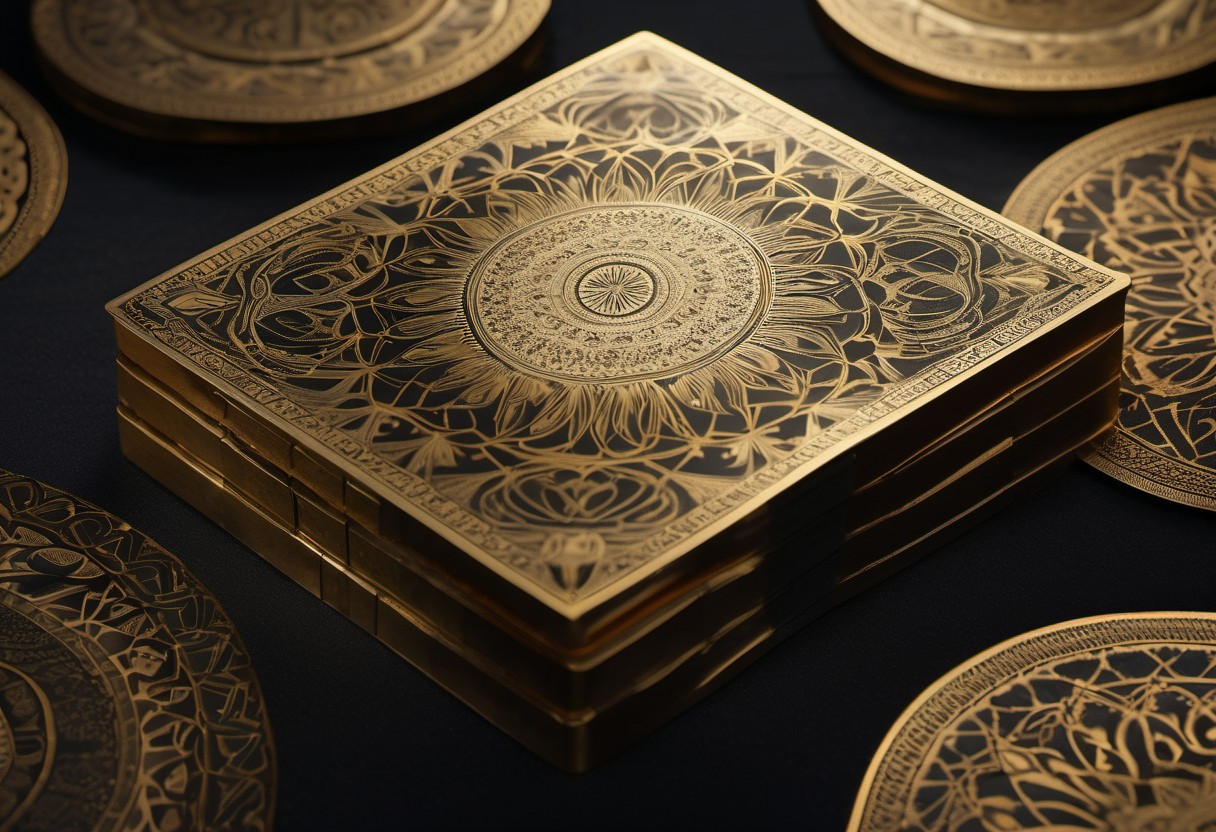
Most people who have had a tarot reading assume the deck is ancient — a survivor of some pre-Christian mystery tradition, smuggled out of Egypt or handed down by wandering Romani mystics. It is a good story. It is also, almost entirely, wrong. The tarot deck is a European invention with a documented birthdate, a known geography, and, for its first three and a half centuries of existence, no connection whatsoever to fortune-telling.
Tarot began as a card game. Specifically, it began as a trick-taking game for the aristocratic courts of northern Italy in the 1440s, a close cousin of games still played today, structurally not unlike bridge or euchre. The cards used to play it were, by sheer historical accident, gorgeous enough and symbolically rich enough that three centuries later a Parisian scholar looked at them and decided they must be something else entirely — a lost book of Egyptian wisdom. He was wrong about the Egypt part. But his wrongness is, in its own way, the most important thing that ever happened to tarot.
That gap — between what tarot actually was and what it was later claimed to be — is not a scandal to be smoothed over. It is the real story, and it is more interesting than the myth it replaced: an ordinary set of playing cards, transformed by Enlightenment-era misreading, occult ambition, and one extraordinary piece of commercial art, into the most recognisable symbolic system in the Western world.
A Renaissance Card Game
Playing cards themselves arrived in Europe in the late 14th century, most likely via trade routes from the Mamluk Islamic world, and spread quickly through Italy, Spain, and Germany. Tarot cards were a later, specifically Italian elaboration of this existing card culture. Sometime in the 1440s, in the courts of Milan, Ferrara, and Bologna, a new game emerged: a standard four-suit deck of cards (cups, coins, swords, and batons — suits still found in traditional Italian and Spanish playing cards) was supplemented with a fifth, extra suit of 21 illustrated trump cards plus a single unnumbered card, the Fool. In Italian this expanded deck was called carte da trionfi — cards of triumphs — and the game played with it became known as tarocchi (the root of the French tarot and the English word).
The game itself was a trick-taking game: players competed to win rounds, or tricks, using a hierarchy of cards, with the trump suit outranking the four ordinary suits. This basic structure is why tarot is often compared to bridge — it is that same broad family of game, and variants of tarot-based trick-taking games (French tarot, Austrian Königrufen, Italian tarocchini) are still played recreationally in parts of Europe today, entirely disconnected from any esoteric meaning.
The most celebrated surviving example from this period is the Visconti-Sforza deck, commissioned by the ducal families who ruled Milan in the mid-15th century. Hand-painted, gilded, and produced as a luxury object for a wealthy court rather than a mass-market product, it survives today only in fragments spread across several collections (the Morgan Library in New York, the Accademia Carrara in Bergamo, and others), with some cards lost entirely. Its imagery — the Wheel of Fortune, Justice, the Sun, Death, the Devil — draws on conventional late-medieval and Renaissance allegorical art: virtues, vices, celestial bodies, and the wheel of fortune were common visual shorthand throughout period painting, sculpture, and manuscript illumination, not secret symbols invented for the cards. A card showing Death as a skeletal figure was not an esoteric code; it was exactly the kind of memento mori imagery a 15th-century Italian would have seen in church frescoes and prayer books.
For roughly 350 years — from the 1440s until the very end of the 18th century — this is essentially all tarot was: a game, played with an unusually beautiful deck, moving from Italy into France and other parts of Europe, with regional variations in imagery and rules. There is no surviving evidence from this period of tarot being used for divination, fortune-telling, or any occult purpose. That is a later invention, and we know almost exactly when it happened.
The Egyptian Myth That Wasn't
The turning point has a precise date: 1781. That year, the French Protestant pastor, scholar, and Freemason Antoine Court de Gébelin published the eighth volume of his sprawling comparative-mythology work Le Monde Primitif (The Primitive World), a project attempting to trace all human religion and language back to a single ancient source. In it, Court de Gébelin included an essay claiming that the tarot deck was not a card game at all, but a disguised remnant of the Book of Thoth — a secret compendium of ancient Egyptian wisdom, supposedly smuggled out of a doomed Egypt and hidden in plain sight among French and Italian card players for centuries, its true meaning forgotten by the very people shuffling it for games of trumps.
If the discovery we are about to relate concerning a game as ordinary as it is well-known, called the Tarot, is interesting for the history of playing cards, it will appear infinitely more so when it is understood that it is a survivor of a very ancient Egyptian book.
The claim had no historical foundation whatsoever, and by the standards even of its own time it was not a wild leap so much as a fabrication built on wishful pattern-matching. Crucially, Court de Gébelin could not read a single hieroglyph, and neither could anyone else alive in 1781 — Egyptian hieroglyphic writing would not be deciphered until Jean-François Champollion's breakthrough using the Rosetta Stone in the 1820s, four decades later and after Court de Gébelin's own death. He was making confident claims about the content of an ancient Egyptian text he had no ability to read, because at the time no living scholar had that ability. The Egyptian connection was, essentially, invented from the general 18th-century fascination with Egypt as a repository of ancient mystery, not derived from any actual evidence in the cards or in Egyptology.
Why did it stick anyway? Partly timing: late 18th-century Europe was intoxicated with Egyptomania and the idea of lost ancient wisdom, a mood Napoleon's Egyptian campaign of 1798 would only intensify. Partly authority: Court de Gébelin was a respected scholar who moved in the same Masonic and intellectual circles as Benjamin Franklin, lending his claim a credibility a lone eccentric would not have had. And partly, the claim arrived at the right moment to be picked up by the next figure in this story — a Parisian wig-maker and grain merchant who saw an opportunity Court de Gébelin himself never pursued.
Etteilla — The First Tarot Fortune-Teller
Jean-Baptiste Alliette, a Parisian who worked variously as a seed merchant, print-seller, and hairdresser, read Court de Gébelin's essay and did something its author had not: he turned the Egyptian myth into a practical system for telling fortunes. Publishing under the pen name Etteilla (his own surname spelled backwards), Alliette produced, from the early 1780s onward, a series of books laying out specific divinatory meanings for tarot cards, upright and reversed.
Etteilla's importance to tarot history is often underappreciated next to the more famous names that followed him, but the claim to a genuine first is his: he was the first person to publish a systematic method of tarot cartomancy, and, in 1789, the same year as the French Revolution, he went further still, designing and publishing an entirely new deck built specifically for divination rather than gameplay, reworking the imagery and even the card order to fit his own version of the Egyptian myth. This was a genuine break with everything that had come before. The Visconti-Sforza deck and its Italian, French, and Swiss descendants had always been game equipment first; Etteilla's deck was the first tarot ever created with fortune-telling as its explicit, primary purpose. He also ran a school of Egyptian cartomancy in Paris and, by most accounts, made a comfortable living at it — arguably making him tarot's first professional reader in the sense the word carries today.
By the time Etteilla died in 1791, the transformation was underway: tarot now had two identities running in parallel, the old trick-taking game still played across Italy, France, and Central Europe, and a new, entirely separate divinatory tradition built on a historical myth that was, by then, less than a decade old.
The Occult Revival
The next major development came from a Frenchman better known by his adopted pen name than his birth name: Alphonse Louis Constant, writing as Éliphas Lévi. A former seminarian turned ceremonial magician and prolific occult author, Lévi published Dogme et Rituel de la Haute Magie (Dogma and Ritual of High Magic) in the early 1850s, and in it he did something neither Court de Gébelin nor Etteilla had done: he connected tarot systematically to the Kabbalah, the Jewish mystical tradition built around the Hebrew alphabet and the sefirot of the Tree of Life.
Lévi proposed a correspondence between the 22 cards of the Major Arcana and the 22 letters of the Hebrew alphabet, and by extension to the paths of the Kabbalistic Tree of Life. This, like Court de Gébelin's Egyptian theory before it, had no basis in tarot's actual documented history — the Visconti-Sforza cardmakers were not encoding Kabbalistic doctrine into a trick-taking game — but it was enormously generative. Lévi's Hebrew-letter correspondence became a foundational assumption for nearly every occult tarot system that followed, woven into the elaborate synthesis of Western esotericism, ceremonial magic, and comparative mysticism that characterised the 19th-century occult revival.
That revival reached its most organised form in the Hermetic Order of the Golden Dawn, founded in London in 1888, which built an entire curriculum of magical training around tarot, astrology, and Kabbalah. It was within this milieu, steeped in Lévi's Kabbalistic framework, that the deck which would define modern tarot imagery was conceived.
The Deck That Changed Everything
If one single event marks the pivot from tarot-as-esoteric-curiosity to tarot-as-mainstream-cultural-object, it is the publication of the Rider-Waite-Smith deck in London in 1909, through the publisher William Rider & Son.
The deck was commissioned by Arthur Edward Waite, a Golden Dawn member and prolific writer on mysticism, who provided the conceptual and symbolic direction. But the deck's actual imagery — every scene, every figure, every composition — was created by the artist Pamela Colman Smith, also a Golden Dawn initiate, working from Waite's guidance but exercising enormous personal creative interpretation in translating abstract esoteric concepts into concrete visual scenes. Smith completed the full 78-card deck in a matter of months, an extraordinary output, and for decades afterward the deck was marketed and referred to simply as the Rider Waite deck or the Waite deck, with Smith's contribution largely unacknowledged on the packaging itself. Only in more recent decades has the corrective Rider-Waite-Smith (RWS) naming become standard, restoring her name to a deck her artistic labour effectively created.
The specific innovation that made this deck so consequential is easy to understate: before 1909, decks used for divination — including Etteilla's and most that followed — typically gave full illustrated scenes only to the 22 Major Arcana cards. The 56 Minor Arcana cards (the four suits of cups, wands, swords, and pentacles, numbered ace through ten plus court cards) were usually decorated but not narratively illustrated — a Five of Swords, for instance, might simply show five swords arranged decoratively, the way an ordinary playing card shows five hearts. Smith illustrated every single card in the deck with a fully realised symbolic scene: her Five of Swords shows a figure standing over two defeated others amid a windswept, hostile sky, an image that communicates emotional and narrative meaning at a glance, without requiring a reader to have memorised an abstract keyword system.
This made the deck radically easier to read and teach, and it is the direct reason the RWS deck became the template most modern tarot decks still follow, whether or not their creators intend an occult meaning at all. Waite's own guidebook, The Pictorial Key to the Tarot, published alongside the deck in 1910, cemented its interpretive framework as a default. When people today picture a tarot card, they are almost always picturing Pamela Colman Smith's compositions.
Crowley's Thoth Deck
The other major branch of 20th-century esoteric tarot comes from Aleister Crowley, the English occultist and former Golden Dawn member who developed his own magical system, Thelema. Working with the artist Lady Frieda Harris across the early 1940s, Crowley designed what became known as the Thoth deck (echoing, deliberately, the same Egyptian mythology Court de Gébelin had introduced generations earlier), reflecting his synthesis of Kabbalah, astrology, alchemy, and Thelemic doctrine.
The Thoth deck's visual language is markedly different from the RWS tradition — more abstract and alchemical, rendered in Harris's art-deco-influenced style. Crowley and Harris finished the artwork by the mid-1940s, but the deck was not commercially published until 1969, both artists having died before it reached a wide audience. Today it stands alongside the RWS deck as one of the two most influential esoteric tarot traditions.
Tarot Today
Tarot's trajectory across the 20th and into the 21st century has been one of steady popularisation, moving well beyond the ceremonial-magic lodges of the Golden Dawn into mainstream, largely secular use. Paperback guidebooks brought it to a mass audience disconnected from any initiatory order, and New Age spirituality from the 1960s onward gave it a new cultural home. More recently, tarot has found yet another framing: a tool for self-reflection and structured introspection, used by people with no belief in literal fortune-telling who find value in the cards as prompts for examining a situation from multiple angles.
This reflective framing has fuelled an explosion of independent, small-press decks in the past two decades, reinterpreting the RWS structure through countless cultural and artistic lenses while generally preserving its core 78-card, 22-Major-Arcana architecture — a direct inheritance from a 15th-century Italian card game, filtered through an 18th-century misreading of Egyptian history nobody at the time could verify.
How Kyshara Reads the Cards
Knowing this history changes how tarot is worth approaching. The cards were never a transmission of ancient certainty; they became a symbolic language through successive acts of reinterpretation — a card game reread as Egyptian scripture, then as Kabbalah, then given fully illustrated form by an artist whose own name was nearly lost to the deck she created. That layered, human history is, if anything, a better foundation for reflective work than a false claim of unbroken ancient authority. The Five of Swords means something because Pamela Colman Smith drew it to mean something in 1909, not because it was smuggled out of a burning library in antiquity.
That is the spirit in which Kyshara uses tarot: one of four disciplines, read alongside astrology, numerology, and BaZi, rather than a standalone oracle claiming final answers. Each system brings a different lens to the same moment in a person's life, and reading them together, rather than treating any single deck or chart as authoritative on its own, is closer to how these traditions were actually refined over time: through accumulation and cross-reference, not singular revelation.
Kyshara's tarot readings are archetypal reflection, not prediction. A card is a mirror positioned at a particular angle, not a forecast. The interpretive process is AI-assisted, drawing on the accumulated symbolic vocabulary the RWS tradition established and the deck traditions that followed it, but the goal is the same one Waite and Smith were reaching for in their own way: to give an abstract situation a concrete image to think with. Explore how this works for you through Kyshara's readings, or step back and see how tarot fits alongside the other three disciplines in The Kyshara Realm.